Case Studies

Page 1 of 14.
A container ship sails at sunset. A smaller ship passes nearby and five more container ships carry cargo on the horizon.

Improved metering to support green fuels in the maritime industry

In 2021, the European Commission adopted the EU Action Plan “Towards a Zero Pollution for Air, Water and Soil” - a key deliverable of the European Green Deal. As the maritime sector accounts for 14 % of the EU’s CO2 emissions from transport, regulations like the FuelEU Maritime Initiative (adopted in 2022) have been created to ...

read more
Against a black background in the foreground is a “forest” of pale blue nanowires with glowing tips

Metrology for quality control of energy harvesting systems using nano-materials

Advanced industrial manufacturing is considered by the EU to be a Key Enabling Technology as this sector is an important driver for European employment and prosperity. One factor limiting the miniaturisation of electronics is battery size. An emerging area that could address this is piezoelectric nanowires. These are sub-micron...

read more
Credit: NPL, UK

The first ISO Technical Standard for nanoparticle concentration

Nanoparticles (NPs) are extremely small – less than 100 nm in size. Due to their high surface area, nanoparticles often have increased activity. This has led to their use in a wide range of modern products, including sunscreen, fuel cells, semiconductors, drug and gene delivery vehicles, or as contrast agents for Magnetic Reson...

read more

Image showing 17 turbines in a rural wind farm against the sunrise

A new procedure for energy meters to support power grid digitalisation

As energy grids across Europe become increasingly decarbonised, reliance on renewable energy sources such as solar, wind and hydroelectric power is becoming more prevalent. However, due to the nature of these sources, their integration into the grid brings with it more variability of supply and more complex conditions. To main...

read more
Image showing a clock with hours spiralling through space

Providing reliable support to orbital-based time and frequency dissemination

Time and frequency dissemination plays a central role in location services, commercial and financial transactions, communication systems such as 5G and the internet, as well as providing a frequency reference used in electricity grids. The most widespread way this is done is via Global Navigation Satellite Systems (GNSS). In Eu...

read more
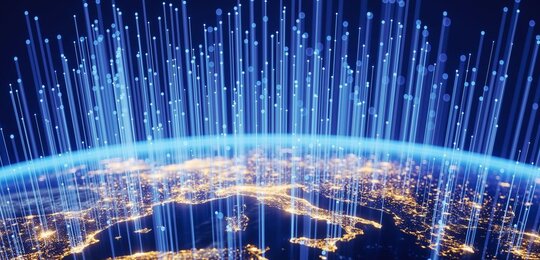
Fibre optic cables rising into space

Dissemination of accurate time and frequency over ground-based optical systems

Almost all areas of modern life require an accurate knowledge of time, synchronised to a common time source. In Europe, time and frequency signals, and hence positioning information, are provided by radio signals or the European Space Agency’s (ESA) Galileo network of 30 satellites orbiting 20 000 km above the Earth equipped wi...

read more
Page 1 of 14.
Element 1 Element 2 Element 3 Element 1 Element 1 Element 1 Element 1 Element 1 Logo-Footer